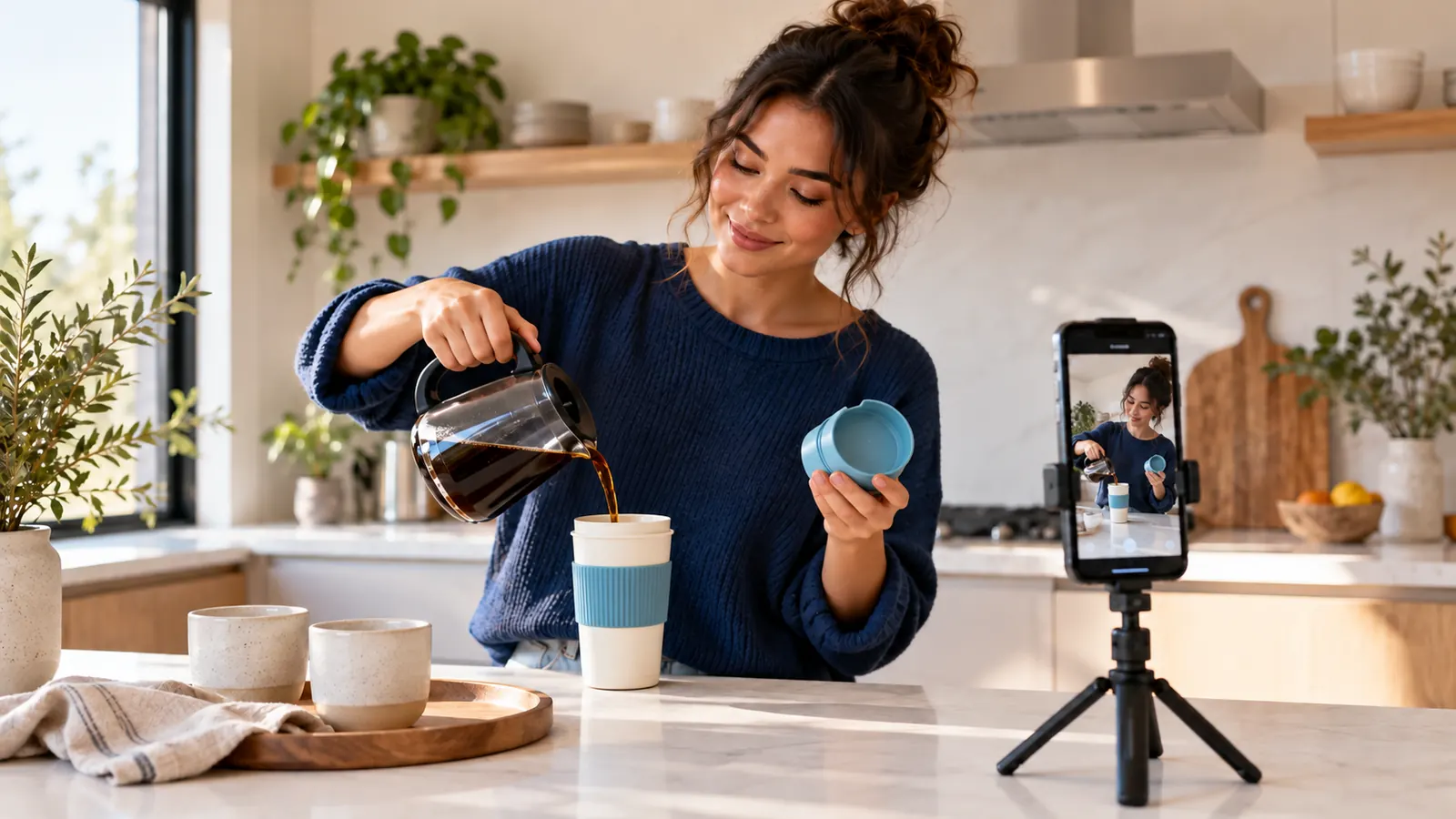
Instagram influencer marketing is a partnership in which a creator introduces a brand through content on Instagram. A useful campaign connects the right audience, a credible demonstration and a clear next step. Paying someone to post is only part of that work.
For a first campaign, choose the customer question before the format. A Reel can demonstrate a product in use; a carousel can explain a comparison; a Story sequence can answer follow-up questions and direct viewers to an agreed destination. These formats serve different jobs and need different reporting.
This guide walks through a fictional reusable-cup campaign, including how to choose creators, agree a manageable scope, budget, check disclosures and evaluate results. Use the campaign brief template to turn the decisions into an offer.
Choose an objective and an Instagram format
Start with one primary outcome: relevant awareness, qualified product-page visits, email signups or tracked orders. Then choose content that helps someone take that step. Do not ask one post to maximize every metric.
| Format | A useful campaign job | What the brief should specify |
|---|---|---|
| Reel | Show a product doing something useful in a real situation | Demonstration, required facts, cover, caption, publication window and reporting |
| Carousel | Explain a process, comparison or buying consideration over several panels | Panel count, sequence, claims, caption, review and reuse rights |
| Stories | Answer objections, add context and offer a next step | Number of frames, sequence, link destination where available, disclosure on relevant frames and evidence before expiry |
For the reusable cup, a Reel might show filling it before a commute and opening the lid at a desk. A carousel could explain how its parts come apart for cleaning. Stories could answer a viewer's question and direct people to a product page. Those are creative options, not predictions about which format will perform best.
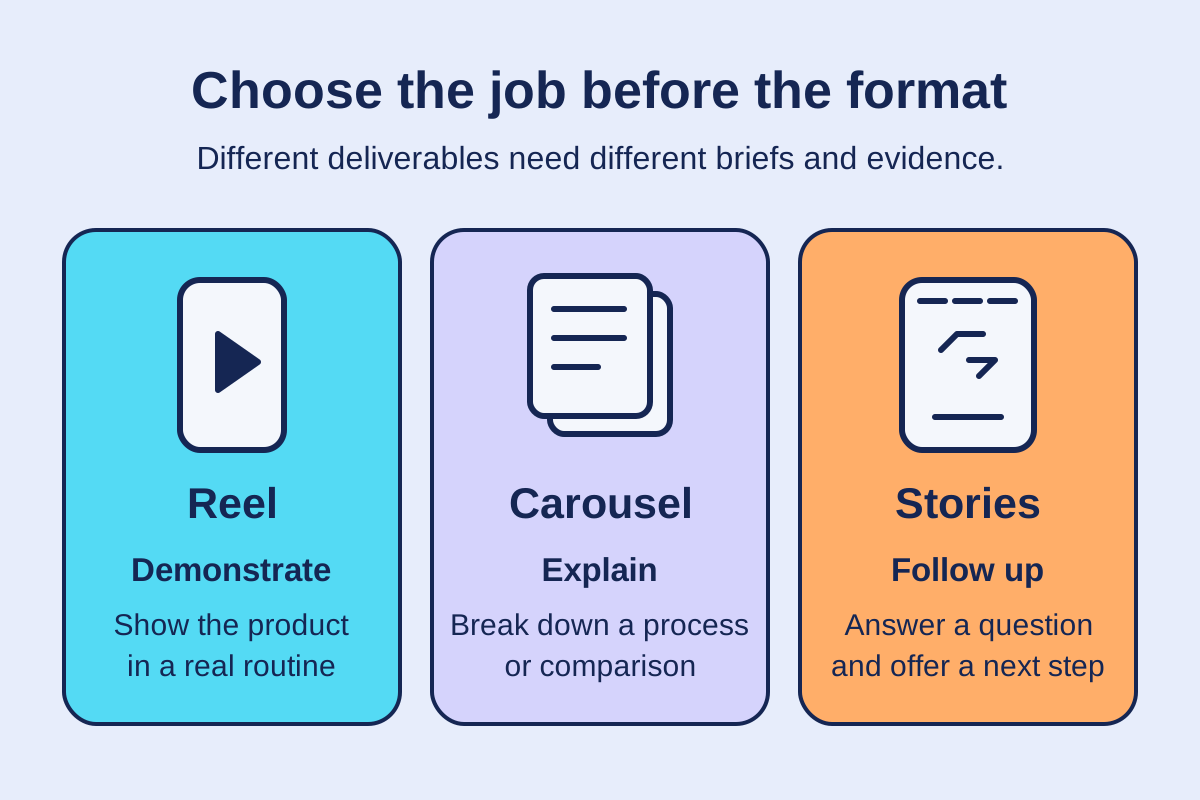
Do not commission every format by default. If the buying obstacle is understanding how a product works, start with a demonstration. Add the cleaning carousel only if that is an important unanswered question. This keeps the scope small enough to learn from.
Find creators whose audience matches the buying situation
Search for the use case rather than only the category. For a cup, that might mean public-transport commuting, office lunch routines or practical travel packing—not simply “lifestyle influencer.” For software, it could be a repeatable workflow the creator already teaches.
Look at several recent, comparable posts. A creator with a large audience in the wrong market is not necessarily a better fit than a smaller creator whose viewers regularly discuss the problem you solve. Ask for dated first-party audience evidence they are comfortable sharing; do not infer geography or purchase intent from follower count.
Build a shortlist with five useful notes for each creator:
- The relevant audience and the evidence supporting that fit.
- A recent example showing they can explain or demonstrate something clearly.
- The range of outcomes across a consistent sample of comparable posts, not just their best post.
- Previous sponsored work, including whether the endorsement is understandable and honest.
- Availability, proposed scope and any competing-brand commitments.
Meta describes Instagram's creator marketplace as a route for discovery and collaboration. Check access in your own market and account; direct research and a creator's published business-contact channel are also options. Marketplace access is not a requirement for working directly with a creator, and Swayed does not claim a Meta integration or affiliation.
When reaching out, show that you understand the creator's work. A useful message is: “Your commute routines look relevant to our reusable cup. Would you be interested in quoting for one product-use Reel and three Story frames, with one revision round and no paid advertising rights? We can send the product for evaluation before you decide.” Replace the scope with what you genuinely need; a sample does not guarantee a positive review or an obligation to post.
Agree the deliverables and rights before production
“One Instagram collaboration” leaves too much unresolved. Put the actual deliverables in the offer and distinguish publication, disclosure and advertising permissions.
| Decision | What to record |
|---|---|
| Content | Format, quantity, demonstration, files and captions |
| Account and timing | Publishing account, draft deadline, posting window and agreed live period |
| Review | Included revision rounds, factual corrections and when a reshoot becomes new work |
| Rights | Brand reposting, website/email use, duration, territory, editing and attribution |
| Advertising | Whether paid use is included, its scope, compensation, platform permission and end date |
| Payment | Gross fee, earning conditions, fees, payment timing and any funded performance cap |
| Evidence | Required reports, exact metric labels, capture dates, tracking window and source |
An Instagram Collab post concerns co-authored publication. It does not replace a sponsorship disclosure or automatically grant advertising rights. Check the intended account setup before promising a Collab workflow.
Meta's partnership ads training treats creator content permissions and paid usage as part of ad setup. Agree those rights commercially and arrange the relevant platform authorization separately. A contract alone does not switch on ad access, and access alone does not explain the duration or compensation you agreed.
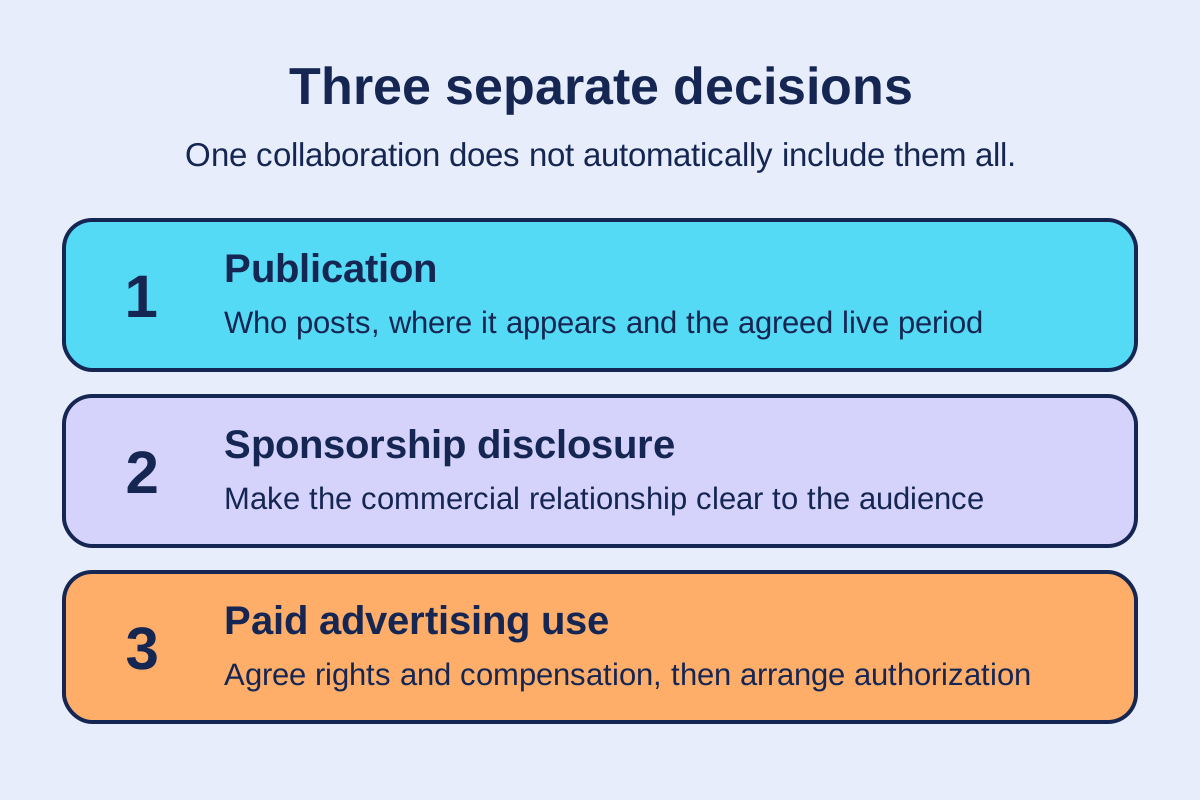
If you may advertise later, request an optional, time-limited usage quote now rather than assuming unrestricted reuse. Also settle rights to music, footage and other material for the intended use. Do not ask a creator to use an audio track simply because it is trending without checking the intended commercial use.
Build a budget that includes more than the post fee
In this fictional example, two creators each quote $600 gross for one Reel and three Story frames, including one revision round. They publish to their own accounts; no carousel, exclusivity, additional reuse license or paid advertising is included. The quote is an illustrative input, not an Instagram rate benchmark.
| Budget item | Calculation | Amount |
|---|---|---|
| Gross creator compensation | 2 bundles × $600 | $1,200 |
| Planned Swayed brand fee | 5% × $1,200 | $60 |
| Product and shipping | Assumed separate cost | $80 |
| Total before tax | Creator compensation + brand fee + logistics | $1,340 |
The platform-funded amount is $1,260 before tax; shipping is outside that amount in this example. At Swayed's planned 10% creator fee, each creator would receive $540 before payout costs if the full fixed fee is earned. Swayed's campaign platform is in prelaunch, so this illustrates its planned fee model rather than a campaign you can currently run here.
Budget separately for management, any software subscription, reuse and paid media you add. The influencer marketing cost guide includes an itemized worksheet and shows how to compare all-in costs with creator compensation.
If you prefer performance compensation, specify the paying metric, eligibility, source, window and total gross cap. For a multi-format bundle, do not add Reel views, Story reach and carousel interactions into one vague “performance” number. Define which deliverables contribute and how. A fixed fee for accepted work is not automatically reduced because views disappoint; see the performance-based campaign guide.
Write a brief that leaves room for the creator
Explain what must be true, not every sentence the creator must say. For the cup campaign, a compact brief could look like this:
- Audience: commuters who regularly carry a hot drink and want an easy-to-clean cup.
- Product question: how does it fit into a normal morning, and how is the lid cleaned?
- Required demonstration: fill the cup, show the lid in use, then show the parts specified in the product instructions.
- Claims: use only supported product facts. Do not invent spill-proof, temperature or environmental claims.
- Creative freedom: the creator chooses the setting, wording and narrative based on their genuine experience.
- Next step: direct interested people to the agreed product page through the available, tested route.
- Scope: one Reel and three Story frames, one revision round, with the dates and rights already agreed.
Give the creator enough time to try the product. Review drafts for factual accuracy, required content and disclosure, not whether they repeat your preferred sales script word for word. If the product does not work for them, resolve that before asking for a favorable endorsement.
Check sponsorship disclosure and publication details
Meta's branded content guidance calls for the paid partnership label when content involves an exchange of value, including relevant gifted products. Confirm the correct label and business partner before posting.
For campaigns reaching U.S. consumers, the FTC's Disclosures 101 guidance says the relationship should be obvious and the disclosure easy to notice with the endorsement. Do not bury it after a caption expansion or among hashtags. For Stories, place a readable disclosure on the relevant frames; for video endorsements, disclose within the video, not only in the caption. A platform label should not be your only disclosure check. Other markets can impose additional requirements.
Before publication, check the actual product, caption, relevant disclosures, links, approved claims and any intended advertising eligibility. Use a phone to test the destination and complete the intended signup or checkout flow. A clickable link is not useful if the page or form behind it fails.
Measure Instagram campaigns without mixing metrics
Choose one primary business outcome and retain the native labels for supporting signals. Views or plays, accounts reached, interactions and website sessions describe different things. Record the name and source shown in the report instead of renaming them all “reach.” Available reports can vary by account and format; agree what evidence the creator can actually provide before commissioning the work.
| Evidence | Where to obtain it | What it can help answer |
|---|---|---|
| Format-specific content metrics | Creator's available Instagram insights, with capture date | What exposure and interaction the content received under the platform's labels |
| Link activity | Available Story link metrics or another agreed route | Whether people used that route, not whether each visit became an order |
| Landing sessions and conversions | Your site's tested analytics and stored signup/order records | What your own site recorded after the visit |
| Paid distribution | Ads Manager, reported separately | What the separately funded advertising delivered |
Give each creator and placement a neutral tracking reference. For example, use utm_source=instagram, utm_medium=creator and a placement label such as cup_reel_a in your agreed link setup. Keep personal information out of URLs. A profile link may serve multiple posts, so do not claim post-level attribution unless the route and reporting support it.
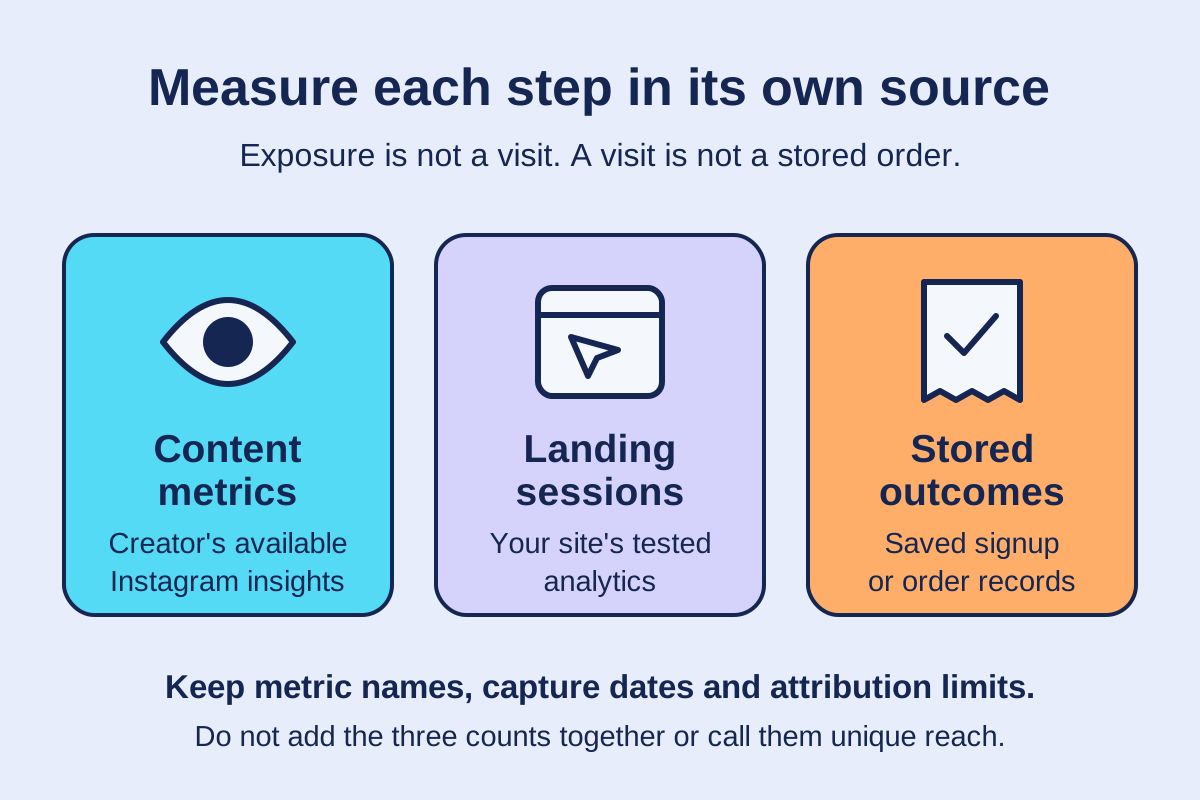
Set evidence deadlines for Stories before they expire and agree a later report for longer-lived content. Save capture times and the campaign's time zone. Do not sum different creators' reached accounts and call the total unique campaign reach without a method to remove overlapping audiences. Keep organic and paid reporting separate when content is amplified.
Use the reporting template to record results. If you calculate an effective CPM, use compatible reported impressions and a stated spend basis in the CPM calculator. Do not substitute unique reach or an unrelated view count just to fill the denominator. Orders attributed by a link or code are useful evidence, but not proof those orders would never have happened without the campaign.
Review the first campaign before expanding it
Ask what you learned about the buying decision. Did viewers understand the demonstration? Did their questions reveal a missing detail? Did qualified visits reach a working product page? Compare the agreed work and costs before assuming the highest-viewed post was the best commercial result.
Repeat the creative hypothesis that earned useful evidence, change one important variable, and buy additional rights or deliverables explicitly. Keep a record of unsuccessful concepts as well as promising ones so the next test addresses a real uncertainty.
Instagram influencer marketing questions
How many followers should an Instagram creator have
There is no follower threshold that guarantees the right audience or a good campaign. Evaluate audience fit, recent comparable content, demonstration skill, terms and evidence. Our micro-influencer guide explains how to build a bounded test with smaller creators.
Should a brand choose Reels or Stories
Choose based on the job. A Reel can hold the core demonstration; Stories can add context and an agreed next step. A carousel can explain details someone may want to revisit. Commission the combination you can brief and measure rather than assume one format always wins.
Does a sponsored post include partnership ads
Not automatically. Agree paid-use scope and compensation, then arrange the relevant Meta authorization. A paid partnership label discloses the relationship; it does not settle every commercial right to edit or advertise the content.
Can I launch this campaign on Swayed now
Not yet. The guides, templates and calculators are available now, while the campaign platform is being built. You can use this workflow independently and join the brand waitlist for launch updates. For a different platform, read the TikTok influencer marketing guide rather than reusing an Instagram brief unchanged.
Swayed Media is currently on the waitlist. Product workflows described here are planned; this guide and its tools are available now.