Free, editable plain-text template. No signup required. Instructions and examples are below.
Download template (.txt)SaaS influencer marketing means working with creators or practitioners to explain a software product to a relevant audience. A useful campaign shows a real workflow, makes its limitations clear and gives viewers a sensible next step, such as trying that workflow or booking a relevant demonstration.
For a software team, the important question is not simply whether a video gets views. It is whether the right people understand the product well enough to evaluate it. A broad productivity audience, a specialist developer audience and an enterprise buying committee need different explanations.
Start with one buyer role, one work problem, one demonstrable outcome and one measurable next step. This guide uses a fictional project-planning app to show how to turn those decisions into a brief, budget and measurement plan. Download the editable software campaign brief above to apply the same structure to your own product.
How SaaS campaigns differ from a product mention
A physical product can sometimes be understood from a short demonstration. Software may need account setup, integrations, a particular subscription tier or a change to an existing workflow. Those conditions belong in the content, not in small print after someone starts a trial.
For B2B SaaS, the person using the tool may not control its purchase. A team lead might want a clearer project handover, while an operations manager needs to know about permissions and implementation. Decide whose question the creator is answering before choosing a platform or a large account.
| Audience situation | A useful content job | An appropriate next step |
|---|---|---|
| An individual can try the product themselves | Demonstrate one task from start to finish | Start a trial and complete that task |
| A team needs to evaluate a shared workflow | Explain setup, collaboration and practical limits | Try a sample workspace or request a relevant demo |
| A specialist needs technical confidence | Show a reproducible integration or use case | Read the implementation guide or test in a sandbox |
| An existing user needs help adopting a feature | Teach the feature in context | Complete the feature's first useful action |
Do not label an onboarding tutorial as new-customer acquisition if it mainly reaches existing users. Both can be valuable, but they answer different questions. Our startup campaign guide covers the wider decision about what a first test should establish.
Choose a workflow and a creator who can teach it
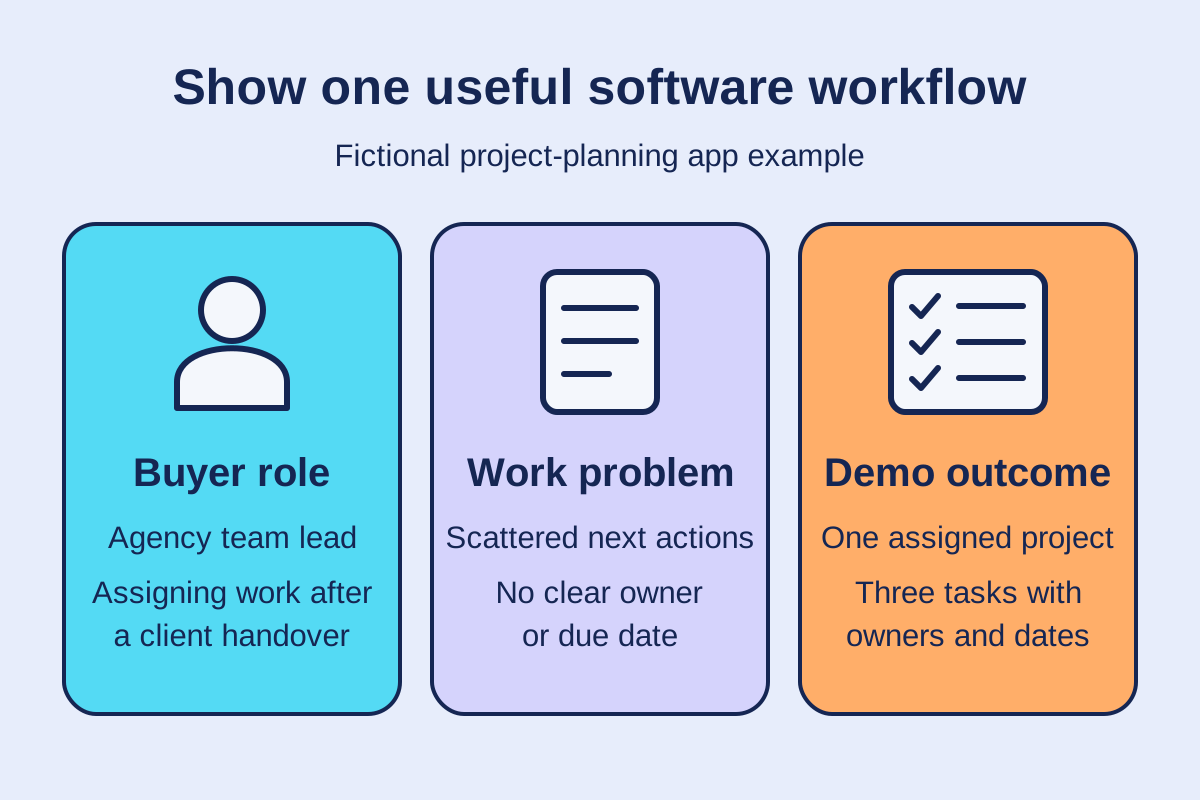
For the fictional project-planning app, “make a video about productivity” is too vague. A better problem is: a small agency needs to turn a client handover into an assigned project without losing the next actions. The demonstration could create a project, add three tasks and assign their owners and due dates.
That scope gives you something concrete to assess in a creator's work. Look for agency operators or software educators who already explain project handovers. An audience full of general technology enthusiasts is not automatically an audience of agency buyers.
Review several recent, relevant pieces of content and ask:
- Does the creator explain the problem accurately, including what happens when a step fails?
- Can they demonstrate the software themselves rather than read a supplied sales script?
- Do their audience's questions relate to the buyer role, workflow and market you need?
- Can they share appropriate, dated audience evidence without exposing private information?
- Are sponsorship disclosures, competing commitments and content rights handled clearly?
Agree on a review sample instead of selecting only the creator's highest-viewed post. A smaller specialist may be a better candidate for a particular workflow, but neither follower count nor a good tutorial guarantees customers. Use the micro-influencer selection guide for a broader shortlist checklist.
Match the format to the explanation
Choose the format after you know how much explanation the task needs. A short video can establish the problem and show an outcome. A longer walkthrough can expose setup details and constraints. A workshop can answer questions, but also needs someone to manage access, moderation and follow-up.
| Format | Useful when | Include in the scope |
|---|---|---|
| Short software demonstration | The task and result are understandable quickly | The action shown, readable screen capture, caption and destination |
| Detailed tutorial or integration walkthrough | The viewer needs setup instructions or technical context | Prerequisites, product version, steps, limitations and supporting links |
| Practitioner interview or newsletter explanation | The buying decision needs context and tradeoffs | The audience problem, concrete example, editorial freedom and disclosure |
| Live workshop | Viewers need questions answered while evaluating | Demo environment, moderator, accessibility, recording rights and follow-up |
Do not automatically buy every format or publish the same edit everywhere. If you use Instagram or TikTok, adapt the demonstration to the screen size and the link route available to that account. See the Instagram campaign guide and TikTok campaign guide for their specific format and disclosure decisions.
Distribution and content production are also separate purchases. A tutorial for the creator's audience is not the same scope as an asset licensed for your own ads, sales material or onboarding. Price the additional use explicitly; the UGC comparison guide explains that distinction.
Distinguish a sponsored deliverable from an affiliate program
A fixed-fee sponsorship commissions agreed work. An affiliate arrangement pays according to its referral and eligibility rules. A community ambassador role may involve education or feedback without purchasing a particular post. Do not assume that calling someone a partner settles the compensation.
For a public software example, Webflow's affiliate program overview describes a referral program for creators and educators, with commissions tied to eligible new subscriptions. It distinguishes those referrals from client work under its partner program. That is an example of a documented commercial structure, not evidence of a particular creator's fee or campaign ROI.
If you commission a tutorial and also offer affiliate earnings, document each part separately. State whether the fixed fee is earned for accepted work, how referrals qualify, which source decides attribution, and how cancellations or reversals affect commissions. Do not describe possible future affiliate income as guaranteed production pay.
Swayed's public site is currently a waitlist for its planned sponsored-campaign workflow. It is not a live SaaS affiliate network, CRM or software-activation attribution service. The planning and reporting steps here can be used with your own tools.
Write a software campaign brief with safe demo access
Give the creator enough access and time to test the workflow before agreeing to endorse it. Supply a dedicated demo workspace with fictional records and the minimum permissions required. Arrange access securely; do not send production passwords, API secrets or customer exports in a campaign brief.
For the fictional handover tutorial, a useful brief would specify:
- Audience: agency team leads who assign work after a client handover.
- Question: how to turn the handover into a project with clear next actions.
- Demonstration: create one project, add three tasks and show the agreed ownership and due-date controls using fictional data.
- Prerequisites: the actual plan, product version, browser and integrations used. Do not imply that paid-tier features are available on every account.
- Boundaries: no claim that the tool eliminates all mistakes or saves a measured amount of time unless that claim is supported.
- Next step: a landing page explaining the same workflow, with matching onboarding instructions.
- Scope: exact formats, publishing account, draft and feedback dates, included revisions, live period and reporting.
Record what the brand may correct: factual errors, unsupported claims, accidental data exposure and missing disclosures. Give the creator room to describe their real experience. If a feature fails or is unsuitable, resolve that before publication rather than requesting a misleading edit.
Set a procedure for product changes. Specify who supplies updated screenshots or instructions, and when a later re-recording becomes separately paid work. A software update should not create an unlimited obligation to remake an accepted video.
Budget for access and operations as well as creator fees
The following is a fictional USD budget, not a SaaS creator-rate benchmark or a Swayed customer result. Assume two creators each quote $750 gross for one accepted software demonstration and organic publication. No affiliate commission, paid advertising, exclusivity or additional reuse license is included.
| Budget item | Calculation | Amount |
|---|---|---|
| Gross creator compensation | Two demonstrations × $750 | $1,500 |
| Planned Swayed brand fee | 5% × $1,500 | $75 |
| Demo environment and access | Assumed campaign allowance | $100 |
| Campaign management | Assumed time or external fee | $300 |
| Landing page and reporting setup | Assumed separate cost | $200 |
| Total before tax | Sum of the five lines | $2,175 |
The platform-funded portion would be $1,575 before tax. Under Swayed's planned 10% creator deduction, each creator would receive $675 before payout costs if the full fixed fee is earned. The other $600 remains part of the campaign cost even though it is outside platform funding. The brand's 5% is on top of gross creator pay, not another creator deduction.
Use actual quotes and internal costs in your own budget. Add any rights, paid media, commissions, tax and additional software costs once, without duplicating costs already included in a bundle. The cost guide and editable budget workbook provide the general worksheet.
If you choose performance compensation, define the payable event, evidence, earning window and funded gross cap before acceptance. Do not equate eligible creator views with activated software accounts. Any additional-video permissions, metric aggregation and bonus conditions should also be visible before the creator commits. See the performance-based campaign guide.
Measure trials and activation before claiming revenue ROI
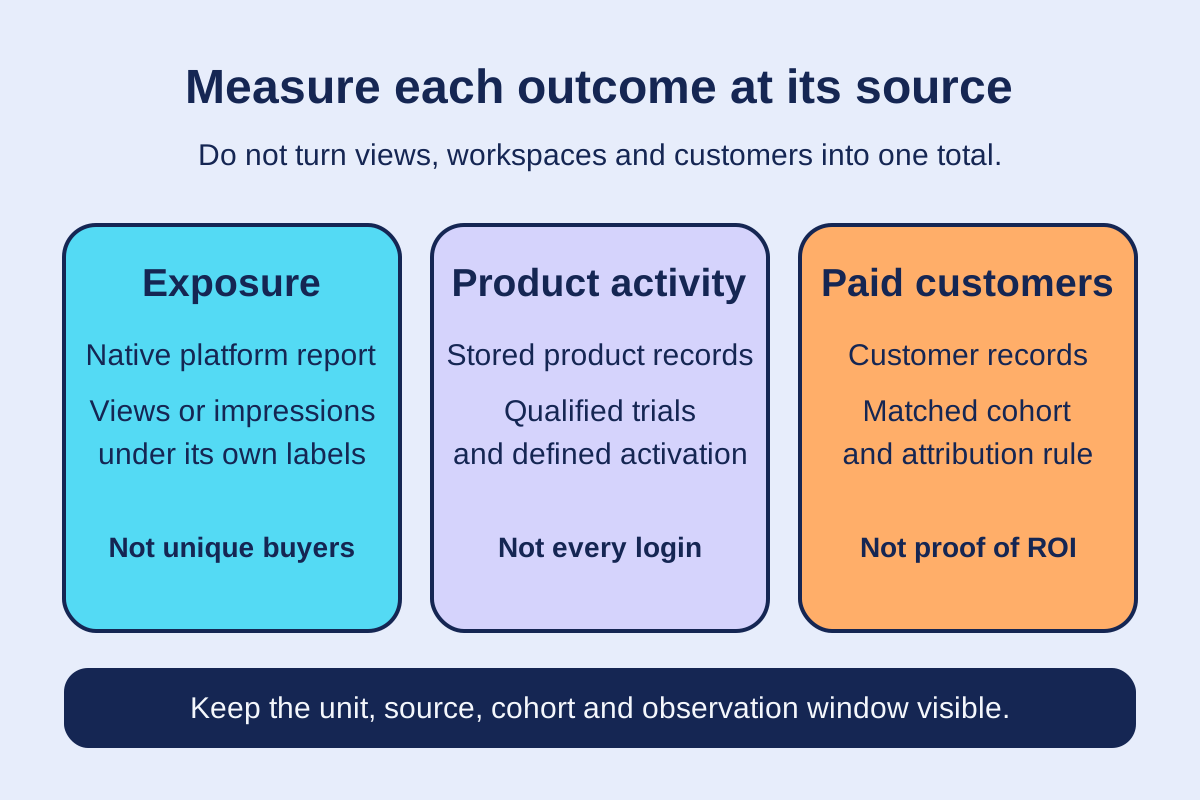
A click, a trial, an activated workspace and a paying customer are different outcomes. Define them with the team that owns your product and customer records. For a team product, decide whether the unit is a person, account or workspace before calculating a conversion rate.
In the fictional example, a qualified trial is a new workspace meeting the campaign's stated audience criteria and excluding test or duplicate workspaces. Activation means that workspace creates its first project with three assigned tasks. These are example definitions, not universal SaaS benchmarks.
| Measurement | Source and definition to agree | What not to infer |
|---|---|---|
| Content exposure | Native platform label, post and observation window | Views or impressions are unique buyers |
| Campaign visits | Tagged destination and your available site analytics | Every visitor saw or trusted the whole tutorial |
| Qualified trial workspaces | Stored new-workspace records and the agreed qualification rule | Every form event became a real trial |
| Activated workspaces | Stored product events for the agreed action | Any login counts as useful adoption |
| Paid customers and revenue | Customer/payment records, matched cohort and attribution rule | Attributed revenue is all incremental or all profit |
Use campaign links with consistent, non-personal labels. Google Analytics documents UTM parameters for identifying referred campaigns. For example, use a platform source, a chosen medium, a campaign name and a neutral creative code such as demo_a. Do not put email addresses, customer IDs or private workspace names into URLs or analytics parameters. Check how your analytics tool classifies the selected medium.
Test the route from publication link to stored trial and activation records before launch. An analytics event alone is not proof that a backend write succeeded. Cross-device journeys, consent choices, shared links and later direct visits can limit attribution. Keep an optional self-reported discovery answer separate rather than using it to overwrite observed source data.
For a sales-led product, distinguish sourced opportunities under your agreed first-touch rule from influenced opportunities with a qualifying creator touch somewhere in the journey. Count unique opportunities and do not add both totals together as separate new revenue. HubSpot's attribution documentation illustrates how different models allocate credit across interactions; those reports are not by themselves experiments proving causation.
A fictional calculation with a mature trial cohort
Suppose the $2,175 campaign produced 30 qualified trial workspaces under the agreed attribution rule. After each workspace has had the same 30-day follow-up window, 12 have activated and three have become paying customers. These are invented teaching inputs, not expected conversion rates.
- Cost per qualified trial: $2,175 ÷ 30 = $72.50.
- Cost per activated workspace: $2,175 ÷ 12 = $181.25.
- Observed activation rate: 12 ÷ 30 = 40% of that trial cohort.
- Campaign cost per attributed new paying customer: $2,175 ÷ 3 = $725.
The last figure is not automatically your company-wide customer acquisition cost or proof of positive ROI. You still need the relevant sales and onboarding costs, actual revenue, contribution margin and a credible view of incrementality. Do not compare one month's subscription revenue directly with an assumed lifetime value and call the difference profit.
Keep the cohort dates and attribution window visible. A trial that started yesterday has not had the same chance to convert as one that started a month ago. With zero qualifying outcomes, cost per outcome is undefined, not $0. Preserve these definitions in the campaign reporting template.
Disclose sponsorship and check the published experience
For work reaching U.S. consumers, the FTC's Disclosures 101 guidance covers material connections such as payment and free or discounted products or services. Free software access can therefore matter to disclosure. A creator should describe their genuine experience, not claim to have used a feature they have not tried.
Check that the disclosure is noticeable with the endorsement, including in the video where appropriate, rather than only in a profile or a hidden caption. Use the relevant platform controls and check the rules for the campaign's markets. An affiliate link or free account does not make the relationship self-explanatory.
Before launch, play the actual edit on a phone. Make sure the screen capture, captions and mouse actions are readable; pricing and feature availability are accurate; no customer data or secrets appear; and the destination completes the promised workflow. Confirm rights for third-party assets and any music, especially if you will reuse the tutorial in ads.
Launch a bounded test and decide what to repeat
Run the test around the accepted scope, not a promise to “go viral.” Set production dates, posting windows, observation windows and the cohort follow-up plan. Assign someone to answer genuine product questions and repair a broken onboarding path promptly.
Use the result to locate the next problem. Relevant viewers but few visits may indicate a weak next step. Trials without activation may point to product fit or onboarding friction. Activated accounts without sales need further investigation into the buying process and offer. These are hypotheses to check, not diagnoses a funnel chart can prove.
When a creator's approach seems worth repeating, commission the next scope explicitly. Do not reduce an earned fixed fee just because your trial target was missed. Under Swayed's planned policy, unused campaign funds and their matching unused brand fee remain future campaign balance, not routine cash refunds, subject to the Terms and applicable law.
Start with the outreach templates to ask for availability and an itemized quote. Then use the downloadable SaaS brief to agree the demonstration, safe access, rights, payment and reporting before work begins.
Common SaaS influencer marketing questions
Is SaaS influencer marketing the same as B2B influencer marketing
No. SaaS describes the product category; B2B describes the customer relationship. Software can be sold to individuals or businesses, and B2B creator campaigns can promote services or products that are not SaaS. This guide focuses on software demonstrations and their path to a useful trial or evaluation.
Which platform should a software brand choose
Choose where the relevant buyer already learns and where the workflow can be explained clearly. Test a specific format and creator, rather than assuming one platform is best for all software. A technical integration walkthrough and a simple visual productivity task can need very different treatments.
Should we pay only for trial signups
Only if both parties accept a clearly defined, verifiable performance arrangement. Specify the qualified event, attribution rule, exclusions, window, payment timing and funded cap. A brand's incomplete tracking should not become an unstated reason to withhold an accepted fixed fee. An affiliate program is not automatically the right way to commission production work.
How long should a first SaaS creator test run
Allow for product evaluation, production, posting and the actual buying or trial cycle. Choose a window you can observe consistently; do not promise that every SaaS campaign will produce meaningful sales evidence in a fixed number of days. Report immature cohorts separately until their agreed follow-up period has elapsed.
Can I run this campaign on Swayed now
Not yet. These planning resources are available now, while Swayed's campaign platform remains in prelaunch. Join the brand waitlist for launch updates; do not assume the public site currently connects your software product events, CRM or affiliate commissions.
Swayed Media is currently on the waitlist. Product workflows described here are planned; this guide and its tools are available now.